Atlas
Agent roster
What each agent can and cannot do, its model route and its cost per claim.
Industry pack · Insurance
Agents re-read closed and open claims for missed subrogation, overpayment and deadline risk, draft demands where every sentence cites the file, and a named specialist signs. Shown for Harborline Mutual, a fictional carrier.
 Simulated data
The problem
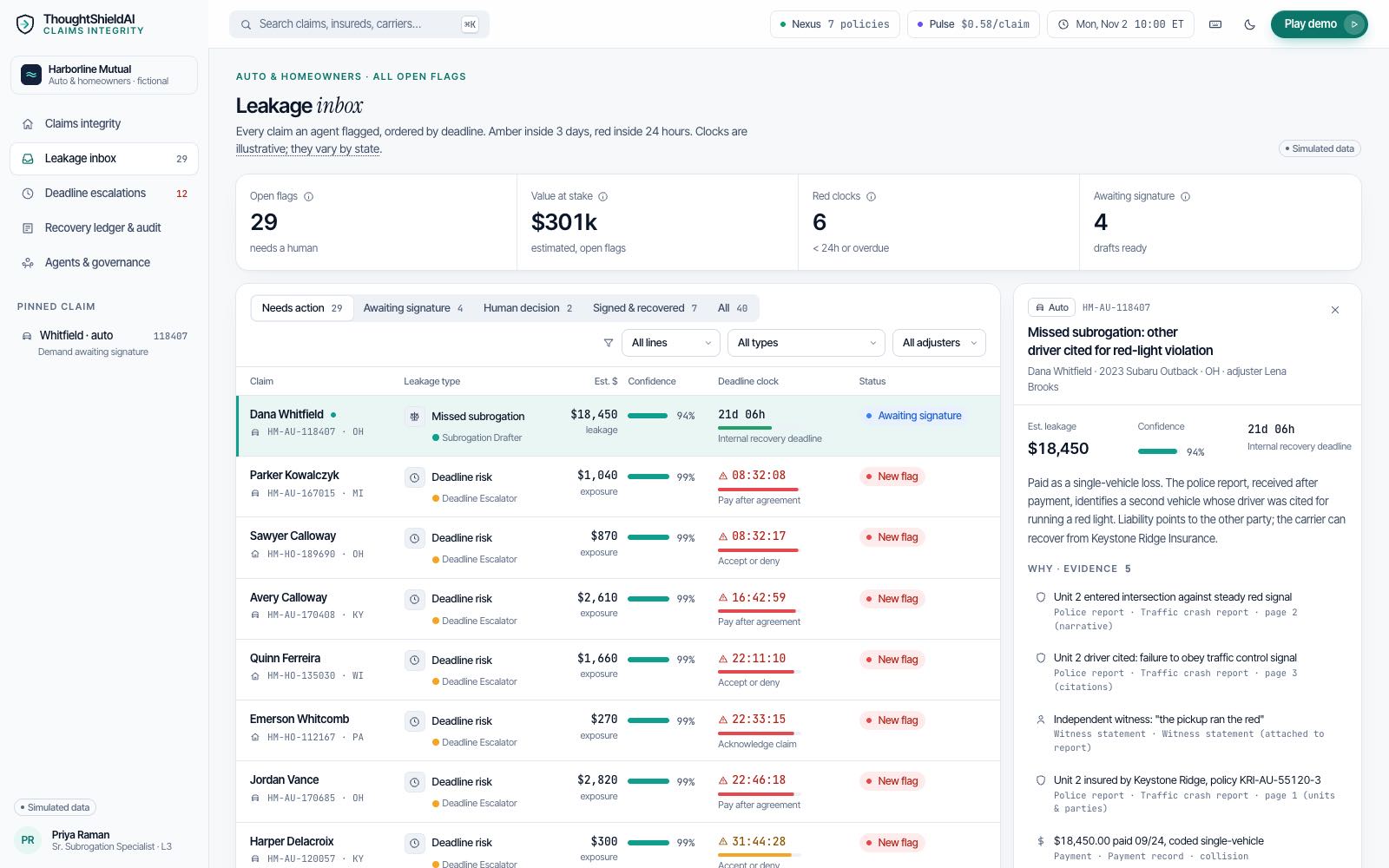
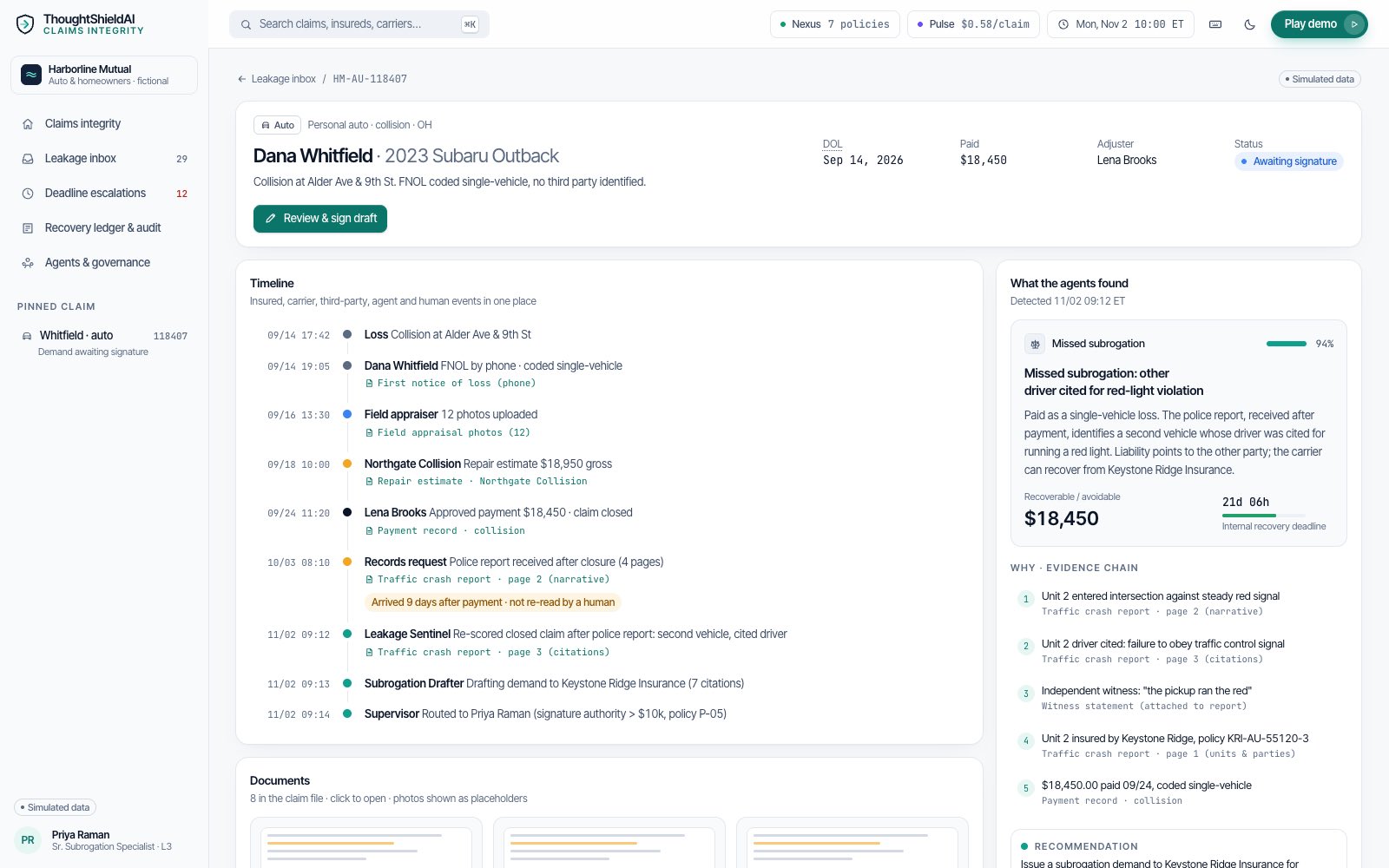
A claim is paid and closed. A police report arrives nine days later naming another driver at fault, and nobody re-reads the file. The recovery right is still there, but the clock on it is running.
Police reports, invoices and estimates that arrive after payment rarely trigger a second look.
Acknowledge, decide and pay clocks vary by state and line; internal recovery windows sit on top. The rules shown in the demo are illustrative.
Automation that denies claims is a risk. Every adverse decision has to be a human one, and auditable.
How it works
The healthcare pattern on the ThoughtShieldAI platform: catch early, draft with evidence, a named human signs, clocks escalate, the ledger counts. Nexus governance and Pulse cost tracking are visible throughout.
Re-scores open and closed claims when new documents arrive, across six leakage types.
Drafts the demand; every sentence cites a page in the claim file.
Holds drafts by value and type for the right human level under Nexus policy.
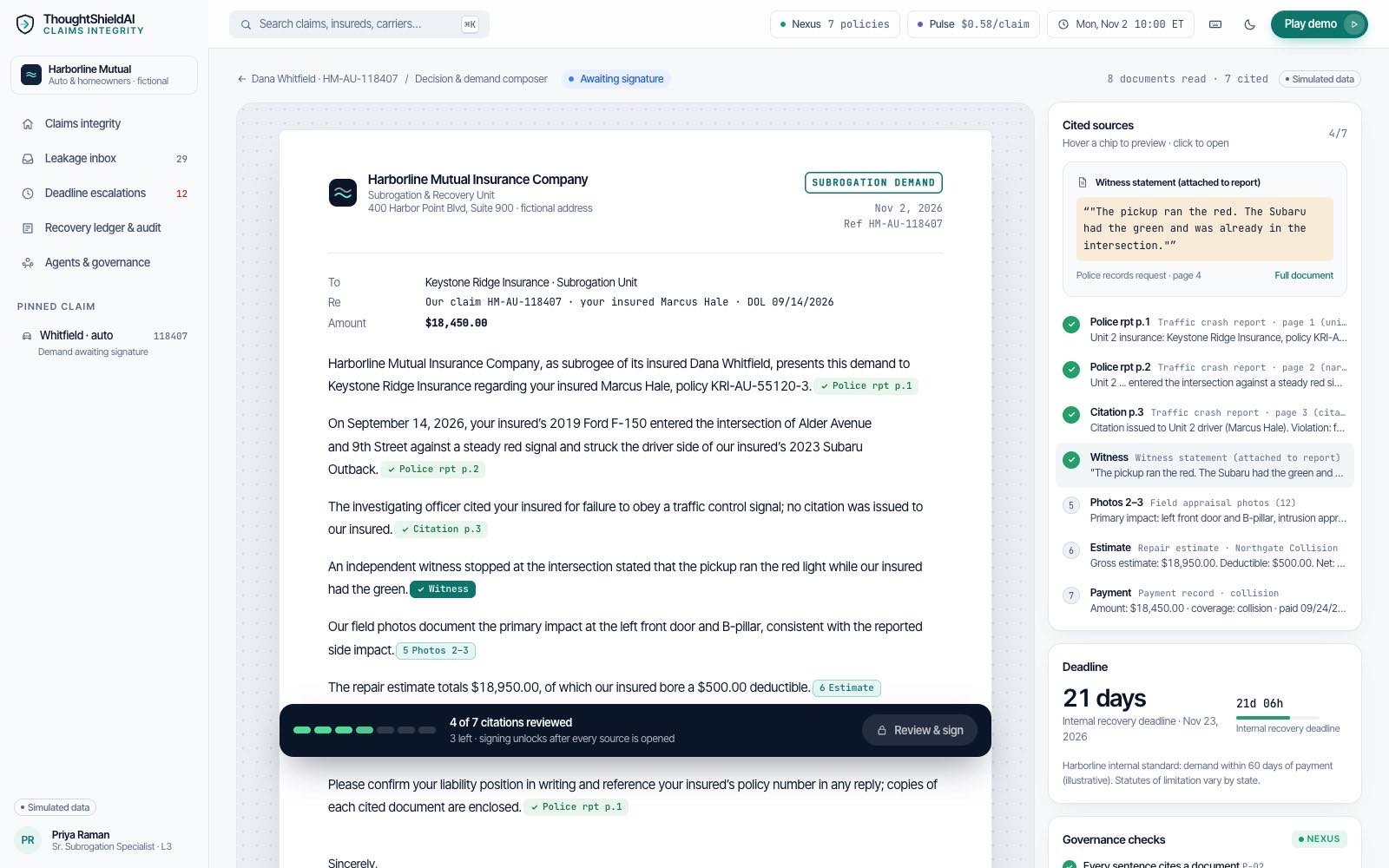
Sign stays locked until every citation is opened. Coverage decisions are always human.
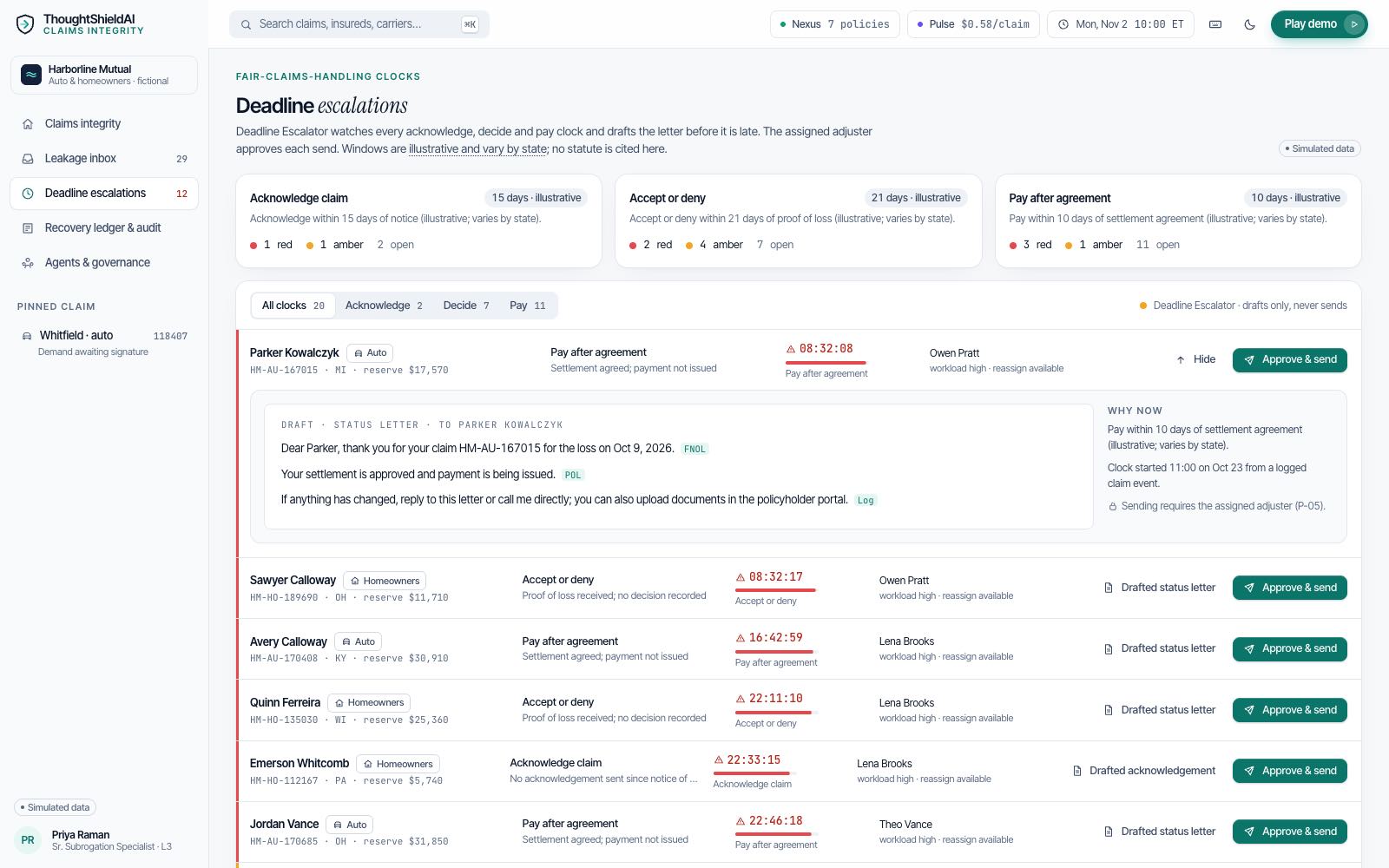
Human stepAcknowledge, decide and pay clocks, with drafted letters for an adjuster to approve.
Leakage prevented, recovered and in pursuit, with value per $1 of model spend.
The human approval
Opens all seven citations, then signs the demand. The demo makes zero automated denials by design.
The scenario
A fictional personal auto claim at Harborline Mutual. People and carriers are fictional; deadline rules are illustrative.
01
The Leakage Sentinel re-scores a claim paid at $18,450 and closed, after a police report arrives nine days later. Missed subrogation, 94% confidence.
 Simulated data
02
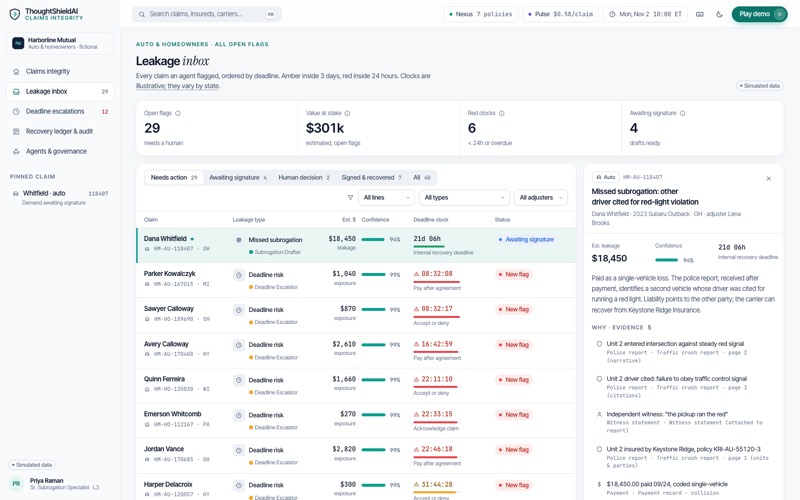
The police report cites the other driver for running a red light, and a witness confirms it. The timeline shows nobody re-read the file after payment.
 Simulated data
03
The Subrogation Drafter writes 8 sentences with 7 citations. The Supervisor holds it for an L2+ specialist with 21 days left on the internal deadline. Priya Raman opens all 7 and signs.
Simulated data 04
Acknowledgement and status letters are drafted ahead of illustrative deadlines for an adjuster to approve and send.
 Simulated data
05
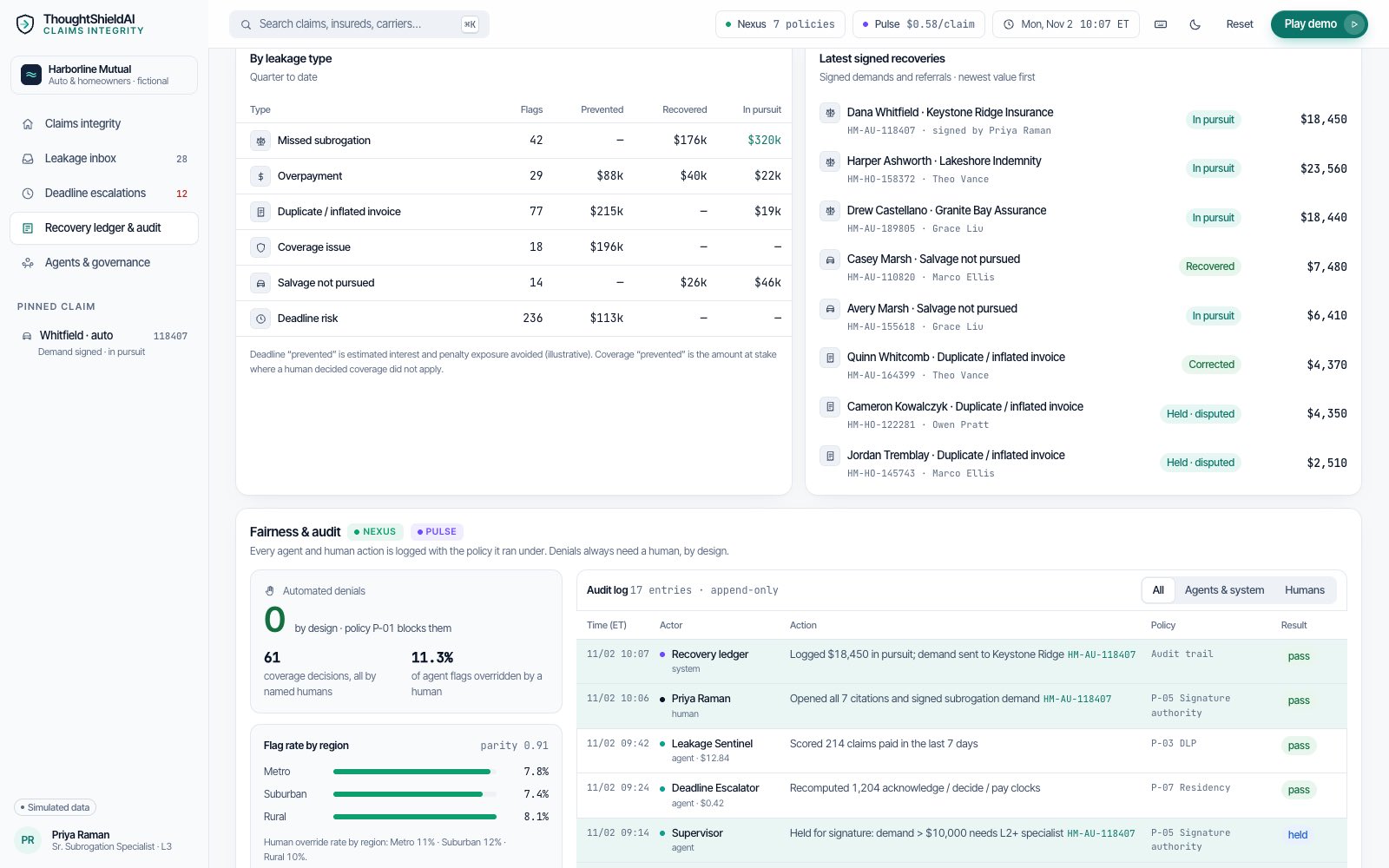
"In pursuit" rises by $18,450. The audit log shows every step, and the model cost for the claim is $0.47.
 Simulated data
Governance and lineage
The decision chain behind this scenario, as ThoughtShieldAI records it. Each step can be opened in the live demo.
FNOL, payment record, police report (received 9 days after payment), witness statement
Leakage Sentinel: missed subrogation at 94%; Subrogation Drafter: 8 sentences, 7 citations
Supervisor holds for L2+ specialist under policy P-05; 21 days to internal deadline
Priya Raman, Senior Subrogation Specialist, opens 7 of 7 citations and signs
Demand logged to the other carrier; $18,450 in pursuit; $0.47 model cost
Atlas
What each agent can and cannot do, its model route and its cost per claim.
Nexus
Value and type thresholds for human review; no automated denials; coverage decisions only by people.
Pulse
Model spend by agent and value recovered per $1 of spend.
Security
Human override rate, flag-rate parity by region and an append-only audit log.
Live demo
The full Insurance Claims Integrity app runs right here, offline, with simulated data. Press Play demo for the guided scenario (about 76 seconds), or click around freely. Reset is in the top bar.
Designed for screens 1280 px and wider. On a phone it opens full screen.
Outcomes
SimulatedSimulated outcomes for a fictional carrier. Not a customer result.
No. Coverage decisions, denials and reservations of rights are only made by people. The demo records zero automated denials by design.
The demo covers six types, including missed subrogation, overpayment, vendor invoice disputes and salvage, plus deadline escalations.
No statutes are cited. Clock rules in the demo are illustrative and vary by state in practice.
No. Harborline Mutual, the people and the claims are fictional, and the data is simulated.
A 30-minute walkthrough of the live demo, then a conversation about the agents, data and approvals in your environment.
Opens an email to hello@anvevoice.app